
Author: Apex Engineering Sales | Last updated: July 16, 2026
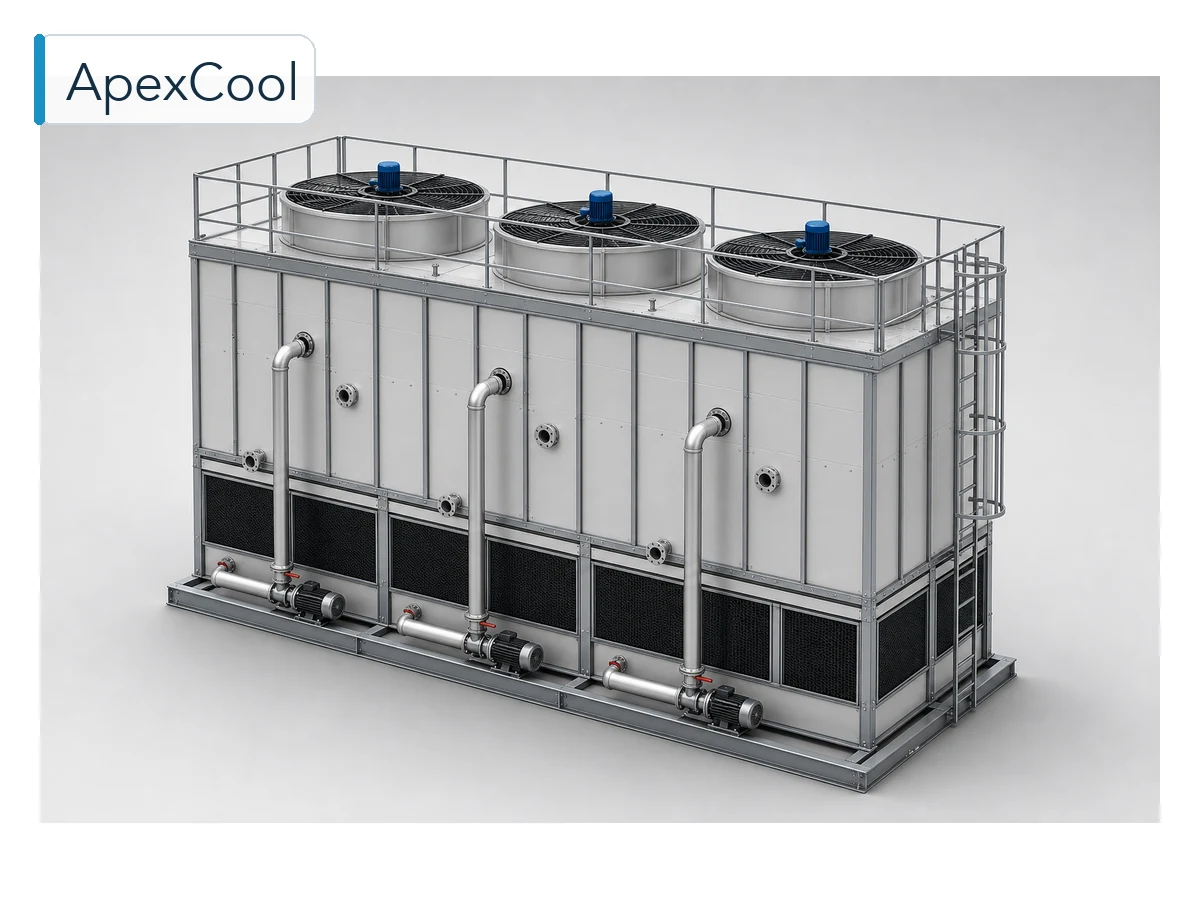
Featured image placeholder: Use an authorized closed-circuit cooling tower product image before publishing.
Quick Answer
For many closed-circuit cooling tower projects, the real comparison is not just “closed circuit or not,” but whether counterflow or crossflow is the better fit for the required approach, layout, service access and process conditions. The right choice depends on the full duty and site review.
Counterflow vs. Crossflow Closed-Circuit Cooling Tower
SCCI SERIES DATASHEET
Download Full Specification Sheet (PDF)
Enter your business email to receive the SCCI cooling tower specification sheet and let Apex know which series you are reviewing.
| Type | Typical project question | What the engineer should review |
|---|---|---|
| Counterflow closed circuit cooling tower | Is a more compact vertical airflow arrangement needed? | Approach target, maintenance access, fan arrangement, piping and service space |
| Crossflow closed circuit cooling tower | Is side access or another service layout more practical? | Footprint, access path, distribution layout, coil service and structural conditions |
When Buyers Search “Closed Circuit Cooling Tower”
This keyword usually signals stronger technical intent than a general “cooling tower” search. Buyers are often dealing with process fluid cleanliness, a closed loop, reduced contamination risk or a system where stable heat rejection matters more than low initial price alone.
That is why a useful page for this keyword should not make generic promises. It should help the buyer understand what data is needed for review and what tradeoffs may affect the configuration.
Inputs Needed for Closed-Circuit Selection
- Circulating fluid type and whether it must stay isolated
- Required flow rate
- Entering and leaving fluid temperatures
- Design wet-bulb temperature
- Site altitude
- Available footprint and maintenance clearance
- Power supply and any noise target
- Material preference and water quality notes
Typical Closed-Circuit Applications
- Industrial process cooling loops
- Equipment cooling where fluid cleanliness matters
- Selected HVAC heat rejection duties
- Data center support cooling, subject to full system review
- Projects where the owner wants better control over loop contamination exposure
Common Mistakes in Closed-Circuit RFQs
- Using “closed loop cooling tower” and “closed circuit cooling tower” as if no duty clarification is needed
- Not stating the process fluid type
- Skipping wet-bulb temperature and only sending ambient air temperature
- Ignoring maintenance access until layout approval stage
- Assuming counterflow is always superior without checking project constraints
Related Apex Pages
- SCC Counterflow Closed Circuit Cooling Tower
- SNC Crossflow Closed Circuit Cooling Tower
- Request a Quote
FAQ
What is the difference between counterflow and crossflow closed-circuit cooling towers?
The difference is mainly in airflow and water distribution arrangement, which affects footprint, access, service pattern and sometimes project fit. Final selection should follow engineering review.
What data is needed for a closed-circuit cooling tower quote?
Send flow, entering and leaving temperatures, design wet-bulb temperature, fluid type, layout limits, power supply, noise target and material preference.
Can a closed-circuit cooling tower be used for data center cooling?
It can be part of a data center heat rejection strategy, but final suitability should be reviewed against the full system architecture and operating conditions.
Related Articles
Next step: If you already have project data, send your RFQ here and include flow, hot/cold water temperatures, design wet-bulb temperature, site altitude, power supply, noise target, water quality and material preference.
Leave a Reply